
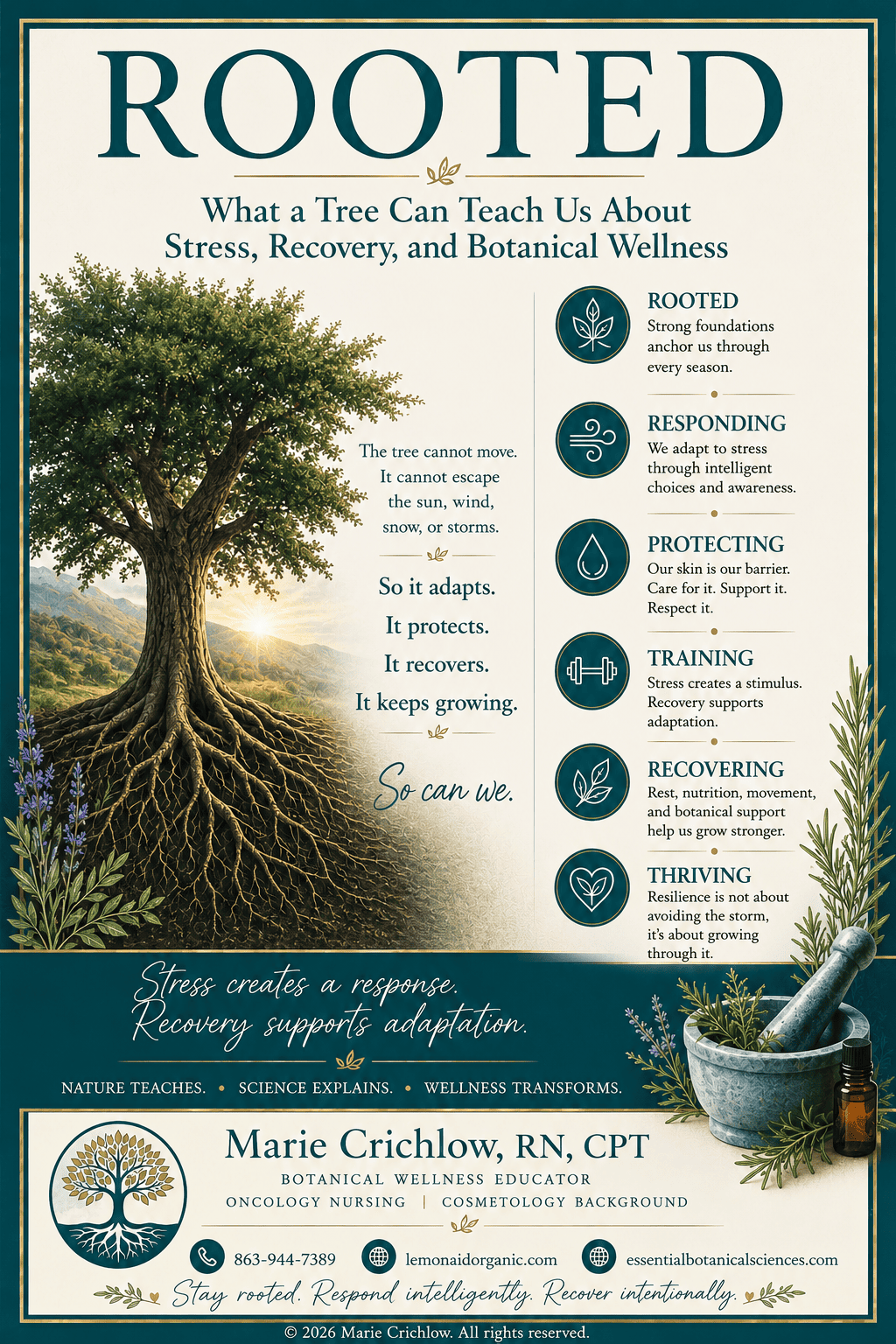
ROOTED: What a Tree Can Teach Us About Stress, Recovery, and Botanical Wellness
By Marie Crichlow, RN, CPT
Imagine for a moment that you are a tree.
Your roots reach deep into the soil. Your trunk rises toward the sky. Your branches stretch outward, and your leaves move with the slightest breeze.
You cannot pack your things and leave when conditions become uncomfortable. You cannot step inside when the temperature rises or find shelter when a storm approaches.
You are rooted exactly where you are.
Then life begins happening around you.
The sun becomes intense. Days pass without rain. Wind pulls against your branches. A storm rolls through. Lightning cracks across the sky.
Winter may bring freezing temperatures, snow, and ice.
Insects arrive. Animals scratch your bark. Something eats your leaves. A branch breaks.
From the outside, the tree may appear completely still.
Inside, however, something remarkable is happening.
The tree is constantly responding to its environment.
Its roots interact with the soil in search of water and nutrients. Its leaves participate in complex exchanges with light and air. Its outer structures provide protection, while its internal chemistry continually responds to changes in the world around it.
Plants also produce an extraordinary variety of natural compounds. Terpenes are one familiar example. These compounds help create many of the aromas we immediately recognize when we crush a rosemary leaf, brush against lavender, or hold peppermint between our fingers.
The plant cannot control everything that happens around it.
It can respond.
That is where the tree becomes more than a beautiful part of the landscape.
It becomes a teacher.
As a registered nurse, certified personal trainer, botanical wellness educator, and skincare professional, I have spent years looking at wellness from different perspectives.
Yet I keep returning to one simple sequence:
Stress. Response. Recovery. Adaptation.
We understand this easily in exercise.
When we train the body, we deliberately introduce a demand. Muscles work. Energy is used. The body experiences stress.
But more stress does not automatically create a better result.
Recovery matters too.
Rest, nutrition, hydration, sleep, appropriate movement, and time all contribute to what happens after the challenge.
Now walk with me from beneath the tree into an herb garden.
Rub a rosemary leaf gently between your fingers. Notice its distinctive aroma.
Move toward peppermint. Lavender. Thyme. Basil. Oregano.
Each plant looks different. Each has its own aroma, chemistry, history, and relationship with the environment in which it grows.
For generations, people observed plants and incorporated them into food, personal care, cultural traditions, and wellness practices.
Today, science gives us additional ways to study those plants and the compounds they contain.
I believe we can respect both perspectives.
Traditional knowledge can inspire questions. Science can investigate those questions. Modern healthcare gives us diagnostic tools and treatments that previous generations never had.
Botanical wellness belongs within that larger picture.
We can appreciate plants without turning them into promises.
That distinction is important to me.
A botanical ingredient does not need an exaggerated medical claim to be interesting or valuable.
Peppermint and menthol can create a recognizable cooling sensory experience in topical products. Other botanical ingredients may contribute warming sensations, aromas, emollient properties, or simply turn an everyday skincare routine into a more intentional experience.
Plant oils can also play a practical role in skin care by helping soften dry skin and support moisture retention.
The point is not to make plants responsible for everything.
The point is to understand them.
ROOTED is ultimately about more than botanicals.
It is about how we think about wellness.
We live in a culture that often encourages us to keep pushing—to do more, work harder, train harder, and move immediately to the next thing.
The tree offers another perspective.
Growth includes response.
Strength includes recovery.
And resilience does not mean never being affected by what happens to us.
Sometimes resilience means having a strong enough foundation to respond intelligently when conditions change.
So the next time you see a tree, look at it differently.
Think about what may be happening beneath the ground where you cannot see it.
Think about the storms it has experienced, the seasons it has moved through, and the branches that continued reaching toward the light.
Then think about your own foundation.
How are you moving? How are you resting? How are you caring for your skin and body? What are you asking your body to recover from? What practices help you remain connected to yourself while life changes around you?
The tree does not need to rush to demonstrate that it is growing.
It remains rooted, responds to its environment, and continues.
Perhaps there is something in that for all of us.
Stay rooted. Respond intelligently. Recover intentionally.
About the Author
Marie Crichlow, RN, CPT is a registered nurse with an oncology background, certified personal trainer, botanical wellness educator, and skincare professional with a cosmetology background. Her work brings together botanical education, movement, skin care, and responsible wellness practices.
Essential Botanical Science
essentialbotanicalscience.com
essentialbotanicalsciences@gmail.com
863-944-7389